Table of contents
To understand the building, it helps to understand the studio. While Dubai’s residential narrative has been carried, for two decades, by a small number of mega-developers, the most quietly influential names in the city’s prime segment tend to operate at a different scale. H&H Development, the team behind Eden House The Park, is one of them. The studio’s output is modest in volume, deliberate in pace, and unusually consistent in tone. The result is a portfolio that has begun to function, within Dubai’s prime market, as a reference point for what a boutique residential developer can be.
A Studio Built On a Different Premise
H&H Development came into public view in the late 2010s, but its founding team’s history in Dubai stretches further back. Profiles published by Khaleej Times and Arabian Business have described the studio as one of a new wave of boutique developers that emerged in parallel with the maturing of Dubai’s freehold market, prioritising end-user buyers and longer-term build quality over the rapid off-plan turnover that had defined the early 2000s.
What separates the studio from larger peers is less a single signature and more a set of operating choices. Project counts are kept low; design teams are repeat collaborators; specifications are written in unusually granular detail; and operations are planned alongside architecture rather than after it. Forbes Middle East, in its periodic coverage of the developer, has framed the approach as “vertically engaged,” a phrase that captures the studio’s tendency to remain involved through delivery and the early years of building management rather than handing buildings off at completion.
The first project to bring that approach into wider view was Eden House Dubai Hills, completed in the years following the pandemic. The scheme, low-rise, wellness-led and built around a central residents’ floor, established the visual and operational template that has since recurred in the studio’s work. Casa Tessuto in Jumeirah extended the language into a softer, more textile-driven palette. Casa Canal, completed on a prime stretch of the Dubai Water Canal, pushed the format into a full waterfront setting with private moorings.
Eden House The Park, in Al Wasl, is the studio’s most ambitious application of that template to date.
“Houses, Not Towers”: A Phrase Worth Unpacking
The studio’s internal shorthand, repeated in successive interviews with regional press, has become “houses, not towers.” The phrase has been picked up in coverage by Arabian Business and Khaleej Times as a kind of design manifesto, but the underlying logic is operational as much as architectural.
A tower, in Dubai’s market vernacular, is typically a high-rise building with hundreds of units, lift cores designed for sky-lobby distribution and amenity floors that serve a large, transient resident base. A house, in H&H’s usage, is a mid-rise volume with a unit count in the dozens, lift cores designed for short trips and amenity floors sized for genuine, regular use by a small community of residents.
The implications run through the whole project. Fewer units means more square footage per resident and more time per resident for the operational team. Lower density means quieter corridors, smaller lift waits, and amenity spaces that do not need to be booked weeks in advance. A smaller, repeating resident community also changes the social texture of the building, something that Knight Frank’s wealth team has identified as an increasingly important factor for ultra-high-net-worth buyers choosing between Dubai, London and Monaco.
A Format With European Parallels
The approach has clear precedents in European boutique developers, although direct comparisons are imperfect. London has its own tradition of low-rise, high-specification schemes in Belgravia and Mayfair, often delivered by small studios working with named architects. Paris has a long-running model of “immeubles de standing” delivered by boutique promoters, and Milan’s recent prime residential renaissance has been driven, in part, by small studios pairing with internationally known architects.
Lodha, the Indian developer that delivered No. 1 Grosvenor Square in London, has been cited in industry conversations as a useful comparable, particularly for its choice to engage senior international design talent on a relatively small number of standout addresses. Collaborations involving figures like Christian de Portzamparc on developer-led schemes in Paris and New York have followed a similar logic: scale the design ambition without scaling the unit count.
H&H’s model, while rooted in Dubai’s regulatory and commercial context, sits comfortably alongside these references. The studio works with specialist consultants on landscape, lighting and acoustics; selects natural materials in the spirit of European boutique hotels; and edits amenity programmes rather than expanding them. The cumulative effect, evident across the studio’s earlier buildings, is interiors and common areas that read as restrained rather than maximalist.
The Wellness Layer
If “houses, not towers” is the structural argument, wellness is the experiential one. Each H&H building has been organised around a central wellness floor, and the format has been refined from project to project. Eden House Dubai Hills introduced the model. Casa Tessuto narrowed the focus, leaning into spa and movement spaces. Casa Canal added waterfront elements. The new Al Wasl project is expected to deliver the most complete iteration to date.
The Global Wellness Institute’s most recent thematic report identifies residential wellness as one of the fastest-growing segments of the global luxury market, with the Gulf region cited as one of the most active geographies for spa-grade residential amenities. JLL’s hospitality insight team has separately noted that the operational model behind H&H’s wellness floors, with dedicated therapy spaces, trained practitioners and structured programming, draws more from five-star hotel operations than from traditional residential management.
The detail matters. A residential gym with a single piece of cardio equipment per twenty units functions differently from a gym with a yoga deck, a movement studio, a recovery suite and an oxygen-controlled cardio room. The latter requires sustained operational investment, dedicated staff and a long-term commitment from the developer. H&H’s pattern, observable across its earlier buildings, has been to make that commitment up front and to maintain it through delivery.
A Studio That Stays Close to Operations
One of the less visible distinctions of H&H Development is its relationship with the operational phase of its buildings. In Dubai, as in many markets, the standard model is for a developer to hand a completed building to an external property manager and step back. H&H’s practice, described in regional press profiles, is to remain operationally involved well past handover.
The studio retains long-term relationships with hospitality-trained management teams, and the amenity programming in its buildings is treated as a continuing operational discipline rather than a fixed asset. Forbes Middle East’s coverage has highlighted this as a defining feature of the studio’s value proposition: the building does not just open well, it ages well.
Knight Frank’s resale data for the developer’s earlier schemes, referenced in successive prime residential bulletins, has shown a measurable premium over comparable contemporaneous projects. Prime brokers active in the segment attribute the pattern in part to operational quality, in part to the lower density of the buildings, and in part to a resident mix that skews end-user rather than short-term investor.
A Quiet Brand
The studio’s communication strategy has matched its architectural one. There are no city-spanning billboard campaigns, no celebrity ambassadors, no theatrical launch events. The website is restrained. Press coverage tends to be triggered by individual project milestones rather than by sustained brand campaigns. Within Dubai’s prime broker community, the developer is known primarily through its buildings and through the small group of senior brokers it works with on a recurring basis.
That quiet posture has, paradoxically, become part of the brand. In a market that has historically rewarded scale and volume, H&H’s deliberate smallness reads as a statement of intent. Bayut’s annual area report has noted, in recent editions, the emergence of a small number of “destination” developers in the prime segment whose buildings command attention disproportionate to their unit counts. H&H sits clearly within that group.
Eden House The Park as a Synthesis
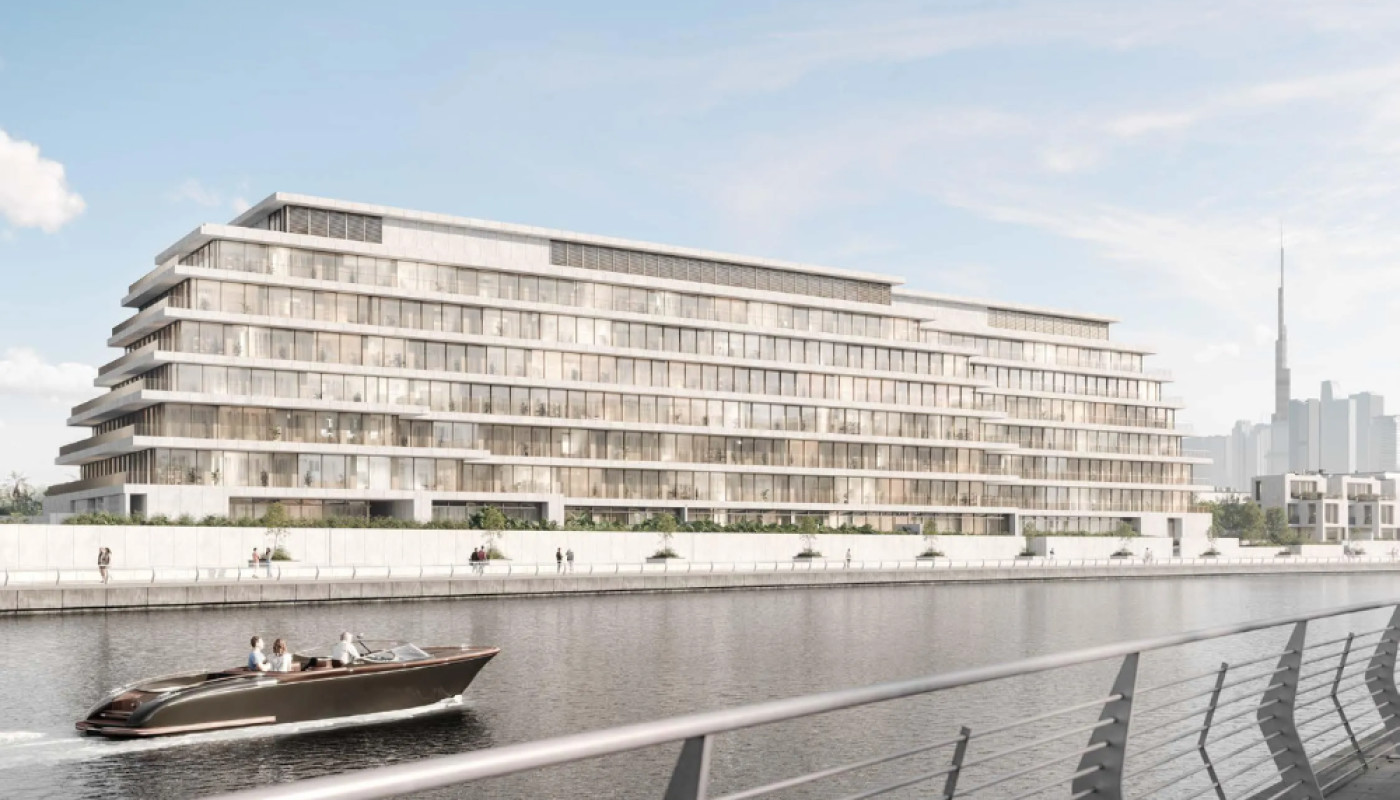
Set against this background, Eden House The Park reads less as a new direction and more as a synthesis. The Al Wasl site provides the studio with one of its strongest contexts to date: a frontage onto Safa Park, proximity to the canal, and a neighbourhood whose character has been shaped over decades rather than years. The architecture extends the studio’s established palette of stone, oak and travertine. The amenity programme leans into the wellness format the team has been refining since Eden House Dubai Hills. The unit count, as with previous projects, is kept deliberately low.
For Dubai’s prime brokers, the official Eden House The Park brochure is being treated less as a product release and more as the next chapter in an evolving body of work. Knight Frank, JLL and Bayut have, in successive market commentaries, identified the boutique-house format as one of the more durable trends in the city’s prime segment, and H&H is the developer most consistently associated with it.
A Long Game
The studio’s choices, taken together, suggest a long game rather than a short one. Buildings are not designed for the first day of leasing. Amenity programmes are not built for the brochure. Operational relationships are not designed to be transferred at handover. Resale performance is treated as a meaningful indicator of design and operational quality, not as a marketing afterthought.
In a city that has earned its reputation, in part, on the audacity of its skyline, that long game is a quieter form of ambition. It does not produce headlines as readily as a record-breaking tower. It does produce buildings that, by the testimony of resale markets and resident retention data, hold their value with unusual steadiness.
Eden House The Park will be judged, ultimately, on those long-term metrics. The early signs, from the launch pavilion, from the broker community, and from the early expressions of interest, suggest a project that is being received in the spirit it was conceived. Quietly, deliberately, and with the kind of attention that boutique studios spend years earning. For H&H Development, the Al Wasl project is both a continuation and, in many respects, a statement of how far the studio’s particular model has come.
On the same subject